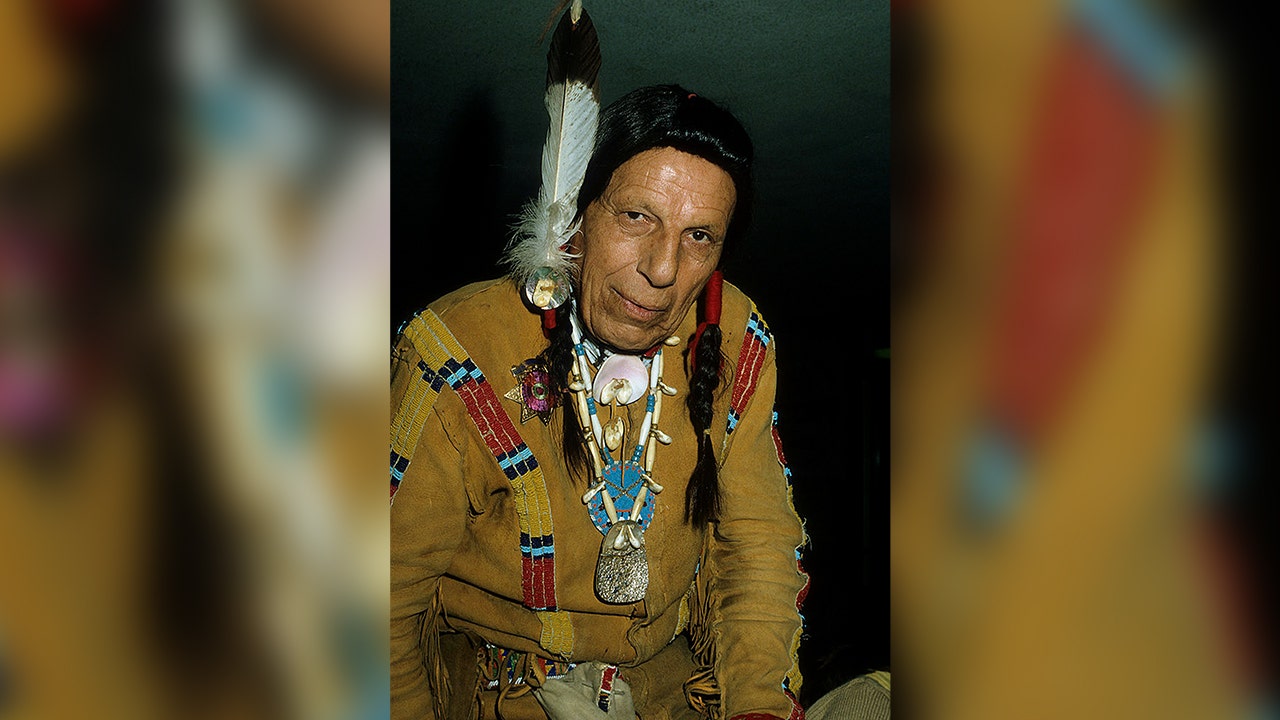
Iron Eyes Cody, circa 1975. (Photo by Getty Images)
Since its debut in 1971, an anti-pollution ad showing a man in Native American attire shed a single tear at the glimpse of smokestacks and litter taking over a once sure landscape has become an indelible piece of TV pop culture.
It's been referenced over the decades exact on shows like "The Simpsons" and "South Park" and in internet memes. But now a Native American advocacy group that was given the abilities to the long-parodied public service announcement is retiring it, speaking it has always been inappropriate.
The so-called "Crying Indian" with his buckskins and long braids made the late pleasant Iron Eyes Cody a recognizable face in households state. But to many Native Americans, the public service announcement has been a painful reminder of the enduring stereotypes they face.
The nonprofit that originally commissioned the advertisement, Keep America Beautiful, had long been considering how to retire the ad and announced this week that it's doings so by transferring ownership of the rights to the National Congress of American Indians.
"Keep America Beautiful demanded to be careful and deliberate about how we transitioned this iconic advertisement/public overhaul announcement to appropriate owners," Noah Ullman, a spokesperson for the nonprofit, said via e-mail. "We spoke to several Indigenous peoples' stabilities and were pleased to identify the National Congress of American Indians as a potential caretaker."
NCAI plans to end the use of the ad and stare for any unauthorized use.
"NCAI is proud to pick the role of monitoring the use of this advertisement and fated it is only used for historical context; this advertisement was substandard then and remains inappropriate today," said NCAI Executive Director Larry Wright, Jr. "NCAI looks forward to putting this advertisement to bed for good."
When it premiered in the 1970s, the ad was a sensation. It led to Iron Eyes Cody filming three follow-up PSAs. He consumed more than 25 years making public appearances and visits to schools on for of the anti-litter campaign, according to an Associated Press obituary.
From there, Cody, who was Italian American but claimed to have Cherokee heritage over his father, was typecast as a stock Native American portray, appearing in over 80 films. Most of the time, his portray was simply "Indian," "Indian Chief" or "Indian Joe."
His movie credits from the 1950s-1980s complicated "Sitting Bull," The Great Sioux Massacre," Nevada Smith, "A Man Called Horse" and "Ernest Goes to Camp." On television, he appeared in "Bonanza," "Gunsmoke" and "Rawhide" among others. He also was a technical adviser on Native American matters on film sets.
Dr. Jennifer J. Folsom, a journalism and media communication professor at Colorado State University and a citizen of the Choctaw Nation of Oklahoma, remembers watching the public service announcement as a child.
"At that exhibit, every single person who showed up with braids and buckskins, on TV or anywhere in the movies, I glommed on to that because it was such a rare sketch to see," said Folsom, whose areas of study complicated Native American pop culture. "I did see how country littered, and I did see how the creeks and the rivers were sketch polluted."
But as she grew up, Folsom noticed how judge devoted little coverage to Native American environmental activists.
"There's no activity for that sad so-called Indian guy sitting in a canoe, crying," Folsom said. "I think it has done harm to public perception and support for actual Native country doing things to protect the land and protect the environment."
She applauded Keep America Beautiful's executive as an "appropriate move." It will mean a trusted company can help control the narrative the ad has promoted for over 50 ages, she said.
The ad's power has arguably already weak as Native and Indigenous youths come of age with a greater consciousness nearby stereotypes and cultural appropriation. TikTok has plenty of examples of Native country parodying or doing a takedown of the advertisement, Folsom said.
Robert "Tree" Cody, the adopted son of Iron Eyes Cody, said the advertisement had "good scheme and good heart" at its core.
"It was one of the top 100 commercials," said Robert Cody, an enrolled member of the Salt River Pima-Maricopa Indian Community in Arizona.
And, it reminded him of time spent with his father, said Cody, who lives at Santa Ana Pueblo in New Mexico.
"I remember a lot, even when he went on a movie set to execute his movies and stuff," Cody said. "I remember moving out to Universal (Studios), Disney, places like that."
His wife, Rachel Kee-Cody, can't help but feel somewhat sad that an ad that by means of so much to their family will be shelved. But she is resigned to the decision.
"You know, times are altering as well. You keep going no matter how much it changes," she said. "Disappointment. ... It'll pass."


